
On changing minds
Objectivity shouldn't be so hard

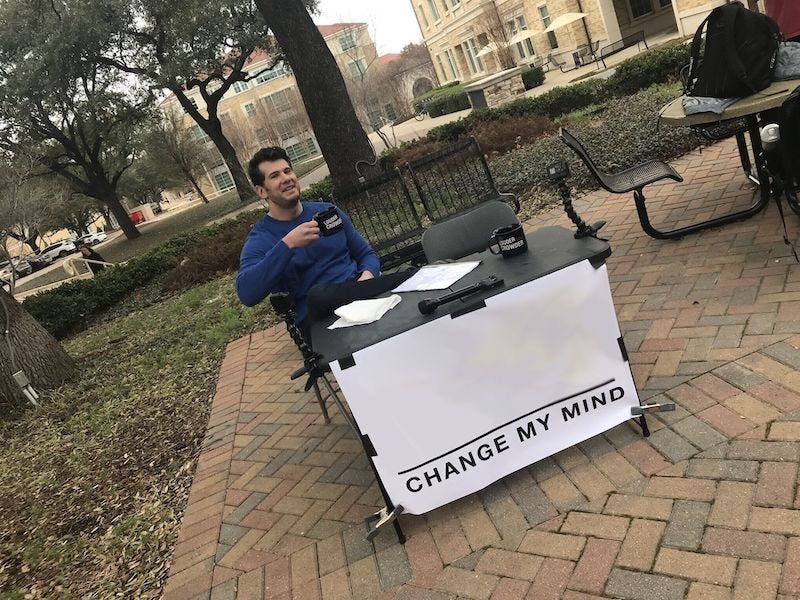
I’m never certain of anything. I feel conflicted about that, too, because, on the one hand, it betrays a clear lack of conviction, but, on the other, people insist that an openness to being wrong reveals a self-awareness that in turn hints at a deeper intelligence. But then, that sounds like cope, doesn’t it? It sounds like something people like me came up with in order to feel less stupid. A self-delusion, an epistemic fig leaf, if you will, with which we hide the nakedness of our own ignorance.
Be that as it may, the ability to change one’s mind when presented with new information, we’re told, is a good thing. On paper, at least, it is an inherently scientific approach to education, to accumulating knowledge, to thinking,. The trick, however, is to not be a sponge, to not uncritically absorb every bad idea and every weak argument ever thrown at you, to not be too easily swayed, to not be so intellectually malleable that there is nothing that you cannot be persuaded of or against. A man’s gotta have some beliefs — fundamental, unshakeable convictions built on a rock-solid foundation of theory and reason and a sense of justice. At least, that seems to be the general expectation.
So, to be of sound intellectual and perhaps moral character is to be aware of your own limitations and lack of sophistication and thus keep your mind open to new and challenging ideas but never so open that you allow your brain to be invaded and commandeered by nonsense. A tall order, honestly. You can realise that you don’t know much, but you cannot crumble under the enormity of all that you don’t know and let yourself be carried away by whatever current of indefensible thought that is in vogue among your equals or, for that matter, your betters. Worse, given that its indefensibility will only ever be apparent in hindsight, how do you even know what line of thought to subscribe to in the moment? How do you ever know what to believe? To really believe?
I, for one, struggle with this more than I care to admit. I never fully know if I’m right about anything. I have a vague notion of being right in a given belief in a given moment, of course, but I can’t be certain that that belief won’t ever be dislodged by a contradictory belief shaped by a new piece of evidence or argument. The threat of an entire worldview collapsing in on itself when a foundational belief is shaken is ever present. This would be fine if it only applied to branches of knowledge that fall within the “hard” sciences, but, annoyingly, it is true for just about everything, from economics and geopolitics to the consumption of media and the calibration of your moral compass. While this is not anything I lose sleep on — it is a mild irritation, at worst — it happens often enough that it makes me at least a little bit insecure in my convictions and a little bit self-conscious when articulating a given position. This is one reason I have decided to disengage from the endless debates online. You can’t change other people’s minds when you’re too busy changing yours.
None of this is to say that I no longer hold any permanent beliefs at all. I do. I still have strong opinions — convictions I feel in my bones. Perhaps more than I ever did in my naive, idealistic youth. But they’re all increasingly narrow in scope as I strive for a kind of ideological specialisation and somewhat niche in that they’re not too reliant on other ideas (or ideals) that I can’t be 100% sure stands up to scrutiny. I now try to ensure a minimum level of structural integrity to my views, intellectually speaking, in that they don’t fall apart at the slightest challenge or provocation. It is hard work and, honestly, I’m not sure I have what it takes to ever be that introspective and the cognitive wherewithal to ever be that objective. All I can do, I guess, is try.